
Our Methods
The Global Restoration Monitor (GRM) represents the global movement on land restoration with a key focus on local action.
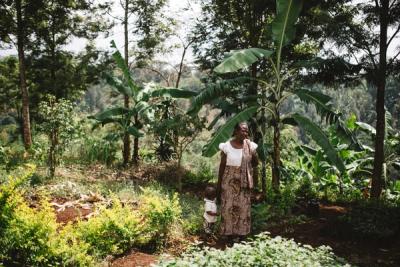
Monitoring.
We place significant focus on the sustainable development of smallholder farmers through the monitoring of key indicators to measure progress and impact.
These key focus areas include:
- People & Communities - Training and adoption of restorative practices, total people benefitting from the program
- Vegetation & Biodiversity - Land area being managed, trees and shrubs planted and/or managed, increase in observed biodiversity
- Carbon sequestration - total tonnes of C02e stored as a result of program activities
- Livelihood security - improved food security, land tenure, intergenerational equity and enhanced social inclusiveness.
By placing communities at the heart of monitoring and evaluation we can better understand how restoration can meet local needs.
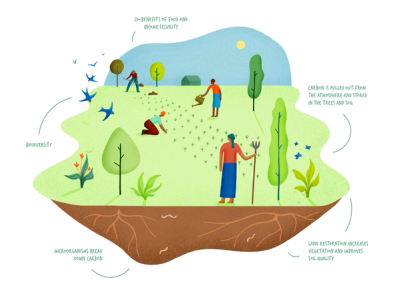
Carbon.
What is carbon sequestration?
Carbon sequestration is the process in which carbon is captured by trees, soil and oceans. This process reduces the concentration of carbon in the atmosphere, and is part of the natural global carbon cycle. Carbon is used by trees for photosynthesis and is broken down by microorganisms in soil and water bodies.
Why do we track it?
We track carbon stored as part of national and global accounts or inventories of greenhouse gases (GHGs). It is important to measure how much carbon is being released into the atmosphere as well as how much is being removed, stored and broken down in reserves or sinks. The resulting carbon budget helps us track the earth’s status in accelerating or mitigating climate change.
What is its role in land restoration?
Climate change mitigation and landscape restoration are often parallel and complementary processes. Restoring lands with additional vegetation and improved soil quality can help improve the productivity of the land with greater diversity and abundance of wildlife, trees that store carbon in the short to medium term, as well as microorganisms that break down carbon in the long-term.
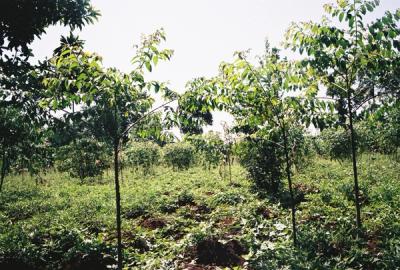
Restoration practices.
Through collaboration we support and facilitate large-scale environmental restoration projects with the aim of improving livelihoods, increasing biodiversity and mitigating and adapting to the impacts of climate change.
Restoring degraded lands is achieved through the promotion of practices such as:
- Farmer managed natural regeneration
- Assisted natural regeneration
- Reforestation & afforestation
- Climate-smart agriculture
- Intercropping & alley cropping
- Terracing, contour bunds & planting pits
- Homegardens